The last true wilderness?
Almost a third of this divide would be ridden in Poland. Both dad and I had high expectations. Hours wandering in the Witcher 3, which is written by a Polish writer, got my hopes up I’d be riding through fields on amazing gravel, and have small villages along the way.
Ofcourse, that’s a video game based on a book and I knew it wouldn’t be as perfect but Poland wasn’t at all what I was expecting. It wasn’t the last empty wilderness of Europe. Houses are scattered everywhere and you see big plots of agricultural land stretching before you.
It still has relatively wild area’s in the North, and the South benefits from the Tatra mountains so this part of the trip is best described in sections.
Southern Poland – Border till Tárnow
The southern region still has a lot of influence of the Tatra mountain range. Climbing up short hills always reward you with a spectacular view of snowcapped mountain peaks. As you wind through and over smaller mountains you have rivers and smaller forests as your surroundings. For cycling this is still a very enjoyable region to be in.
For the true cycling enthusiasts there is also a intense and tough challenge: The Ochotnica Challenge. With 16 climbs -A whopping 26.2% max gradient- and 3514hm it promises to be a ride only for those who are well known with their limits or are willing to push beyond them. I’ve done 3 of the climbs with my loaded bike and that was just fun enough.
The biggest city in this region is Tárnow. As with a lot of towns and cities in Poland it lacks a certain cuteness. Everything is very efficient and you notice a lot of old soviet influences. Not a bad thing but it is something to get used too. To learn more about the daily life we reached out to a warm showers host in this city. We got hosted by a librarian who was happy to tell about the history of Poland and the various wars that have influenced this country so much.


Central Poland
The central part of Poland for me is the area between Tarnow and Kazimeierz Dolny. By far this was the least interesting part to ride. There is hardly any gravel and the paved roads are concrete slabs in various forms. These slabs have been places decades ago and are full of big holes and sharp edges which makes for slow and intense riding. It could be worth it if the scenery was very scenic but unfortunately it’s best described as boring. Perhaps not officially but for me central Poland is the agricultural heart of the country and best skipped or ridden through without much thought.


Northern Poland
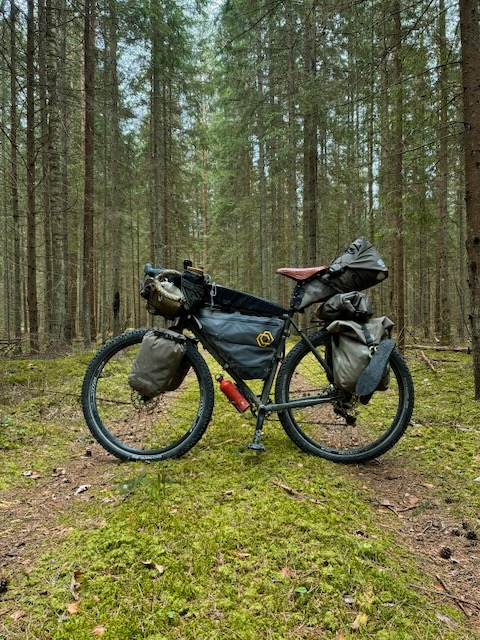
As we got more North we slowly saw the landscape change. Big plots of farmland turned into smaller forests and eventually bigger and wilder forests. Our route followed the Belarus border and at a moment we could see the big fence separating Europe from the strict Belarusian regime. Special enough on its own but there is another big reason to ride a bike through this area: The Primeval forests. North-East Poland and Western Belarus share one of the last true wilderness reserves of Europe. A highly protected nature reserve featuring the last primeval trees and grasslands. You can get access to the inner reserve by taking a tour but even just riding through the adjacent forests feels like a different world. Not only are the trees old and massive but the entire floor is covered in dark green moss and a mix of purple and white flowers.
A incredibly special view.
Besides old trees and fauna there is even more to witness, if you are lucky. The biggest and last herds of Eurasian Bison roam the plains and forests. This might be one of the last remaining places where you have a good chance to see these incredible animals roam free in their natural habitat.
We got lucky on our final day and managed to see a group of 30 bison standing in the field nearby. Spectacular and humbling!


Final thoughts on Poland
Poland won’t be in my top 3 list of this trip but that is mostly because I had set my expectation too high. It is a country with a lot of different landscapes and what I might find boring could be the perfect day for someone else.
There is a newly developed cycling route called the ‘Green Velo’. We intersected this route a couple of times but for me the Northern part was the most interesting.
Accommodations are scarce and illegal trash dumping is still very common unfortunately. As soon as you get near a couple of houses you’ll see tires, trash bags and car parts scattered around. A shame if you ask me, especially if you try to promote cycling in your country.
A thing that stood out very positively for me is the state of their graveyards. Every village has their own and the people are genuinely looking out for the graves. You’ll see fresh flowers or really pretty fake flowers on every grave, often accompanied by lanterns and candles.
There are often a couple of benches to rest, and if you’re lucky a portable toilet too. Usually clean and with toilet paper.
Another interesting, and for me an unexpected, thing is that the non-alcoholic beer section in the supermarkets is almost as varied as the regular beers. Lagers, ciders and Radler in every flavour imaginable, even in the smaller village shops.
Besides a few disappointing days Poland is still a good example why travelling by bike through lesser known countries and regions is so good. You see a country for what it is, the nice parts and the trash. I wouldn’t recommend spending months riding here but for a week or two it is definitely worth a visit. Just don’t except café’s and bakeries everywhere.


Leave a Reply